Materia Botanica
The Damask rose, between Dioscorides and the Eğirdir lake
Two thousand years of writing on a single plant — and the three hours each May in which the year's harvest is decided.
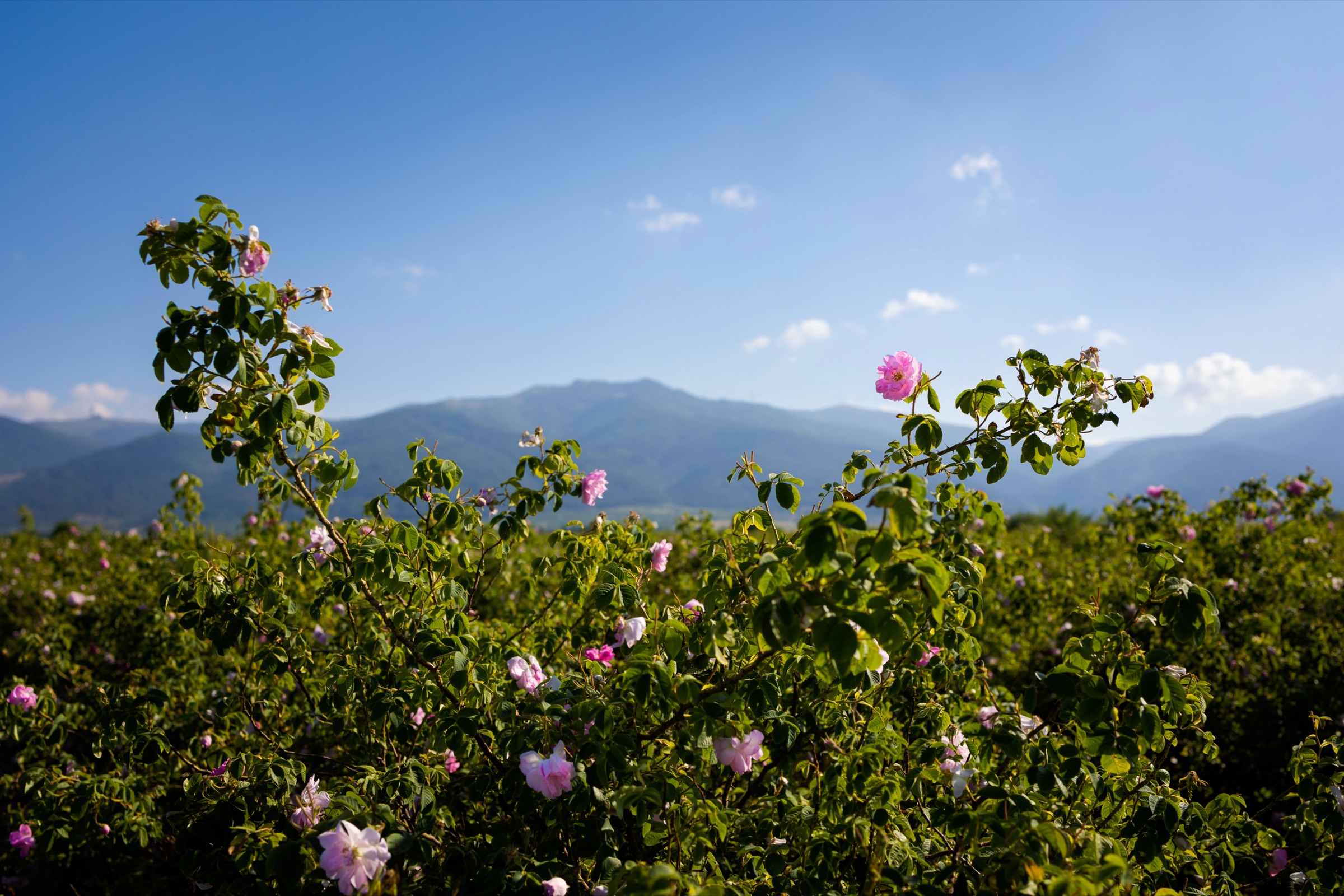
The Isparta plateau sits at roughly twelve hundred metres above sea level, in the southern Anatolian highlands between the Eğirdir lake and the Burdur basin. In May, the air on the plateau holds a particular paradox: warm enough by noon for the cultivated rose to open in full bloom, cool enough at dawn for the same plant to keep its volatile oils tightly bound inside the petal. The Anatolian cultivar of Rosa damascena — the Damask rose, Şam gülü in modern Turkish, gül in the older Diwan poetry — has worked out, over a thousand-year residency on this geography, a chemistry that depends on the temperature gradient. Between four and seven in the morning, the petal carries its full essential-oil load. By eight, the loss is measurable. By ten, the day's harvest has been decided.
This is the first thing one needs to understand about the plant. Not its symbolism — which is enormous, layered across at least four cultural strata, and somewhat misleading — but its hour. The Damask rose is a plant for which timing is the entire practice. The Isparta cooperatives, which today supply roughly sixty percent of the world's rose oil production, have organised themselves around this hour. The harvest begins in the second week of May and ends, depending on the year, between the tenth and the fifteenth of June. Within that six-week window, every morning starts the same way: small vans collect the cutters from the surrounding villages at three; the women — and they are, almost without exception, women — are in the fields by four; the day's haul is at the distillery by eight. A single kilogram of essential oil requires roughly three to four tonnes of fresh petals. The labour is sustained, ancestral, hand-done.
It is tempting to romanticise this. The romance, however, runs counter to the older tradition. The Anatolian household has never spoken about the Damask rose in the elevated register the European cosmetic industry now reserves for it. The plant is gül, a word so embedded in the language that calling someone gül gibi — like a rose — is among the most domestic forms of affection a Turkish household uses. The morning's harvest is gül mevsimi, the rose-season, alongside the spring lambing and the autumn olive in the seasonal vocabulary of rural Türkiye. The product itself comes in four shelf-forms at the aktar — the Anatolian apothecary — and is dispensed by the drop, not the bottle: gül goncası for the dried bud, gül yaprağı for the loose petal, gül suyu for the hydrosol, gül yağı for the oil itself, the latter sold from small vials behind the counter, never measured to a fixed unit. The Eminönü apothecary alleys in Istanbul, which have operated continuously since the seventeenth century, still dispense it this way. The hand of the aktar matches the dose to the body, not to the container.
The written record on the plant is long and oddly stable. The earliest detailed entry appears in Dioscorides' De Materia Medica, the five-volume Greek pharmacological treatise compiled in the first century in Anazarbus, in what is today the Adana plain of southeastern Anatolia. Dioscorides describes the rhódon — the Greek term — as a plant of cosmetic and medicinal value, names two cultivars then in use, and details the distillation of rose-water from the petals. A hundred years later, Galen of Pergamon — working in the western Anatolian highlands at the Asclepieion temple-hospital — refers to the same plant repeatedly in his pharmacological writings, with the same general indications and a more sophisticated understanding of the cooling and astringent action. The Byzantine medical manuscripts of the fourth through eighth centuries carry the Dioscoridean entries forward. The eighth- and ninth-century translation movement at the Abbasid court takes the same material from Greek into Syriac and then into Arabic. By the eleventh century, Avicenna's Canon of Medicine — the foundational text of Seljuk and Ottoman pharmacology — devotes considerable space to gül suyu and gül yağı, citing Dioscorides directly on nearly every relevant entry. The Ottoman court physicians, particularly those of the Süleymaniye Tıbbiyye in sixteenth-century Istanbul, carry the lineage forward without rupture. Two thousand years of writing on a single plant, with the central facts surprisingly unchanged from the first source to the last.
What did change, repeatedly, was the cultural use. The Ottoman hammam tradition — the bathhouse practice that the empire inherited from Roman and Byzantine bath culture and refined into a precise sequence — placed the Damask rose at the bath's conclusion. After the heat-room, after the abrasion of the kese glove, after the alkaline lather of the defne sabunu (the two-year-aged Bursa laurel soap), the bath ended with cold rose-water poured slowly over the head and shoulders. The chemistry behind this gesture is exact: the floral hydrosol is hyperosmotically gentle and slightly acidic, which neutralises the alkaline residue of the soap and closes the skin's surface after the heat. The Ottomans called the resulting state huzur — quiet, settled — and used the same word for the comparable state of mind after evening prayer. The plant marked the soft thresholds of life. Brides received rose-water on the eyes before the wedding. Mothers used it to wash newborns. The dead were prepared with it before burial. The Damask rose, in the Ottoman household, marked the gentle openings and closings.
The cultivation today remains family-held. Isparta's rose oil production runs through small village-level cooperatives — most of them organised at that scale, most of them refusing the consolidation that would convert the harvest into industrial scale. The reason is not nostalgia. The reason is that the plant's chemistry is held by the soil, the altitude, and the harvest hour, and any one of these is broken by industrial conversion. The Isparta cultivar produces essential oil with an unusually high citronellol fraction — between fifteen and twenty-two percent of the volatile compounds, compared with closer to ten percent in the better-known Bulgarian Kazanlık valley production. The phenethanol share is also noticeably higher than in the Iranian Kashan harvest. Geraniol sits slightly lower than the Iranian counterpart. The resulting profile is, by every measurable standard, rounder, less sharp, and more skin-tolerant in clinical patch testing.
The Damask rose has also held a quiet place in Anatolian visual culture for as long as it has held the kitchen and the hammam. The blue-and-white Iznik tiles of the sixteenth century — produced in the Bithynian town for which this maison is named — show the same rose over and over, in opening clusters of three or four blooms, drawn with botanical precision rare in decorative ceramics of the period. The Topkapı Palace gallery in Istanbul holds rooms tiled almost entirely in this pattern. The painters of Iznik knew the plant from the gardens around them; the precision of the rendering testifies to the fact that the rose was, for the Ottoman court, not an abstract symbol but a particular plant with a particular hour and a particular smell.
An Isparta cooperative can give this scale a face. One village-level cooperative — founded in the mid-twentieth century, today around eighty member-families — works roughly twelve hundred hectares of rose-field at the northern edge of the Eğirdir lake. The cuttings are made by the women of the member families, in three-hour shifts beginning at four in the morning; the petals are at the cooperative's two stills by eight. The hand-distillation, which most industrial European rose-oil operations have abandoned for solvent extraction, is here retained — partly because the Anatolian cultivar's specific chemistry survives copper better than steel, partly because the families measure their work-year in gül mevsimi, and equipment that has worked for three generations is not lightly replaced.
Three regional factors write this distinction into the petal. The Göller Bölgesi altitude exposes the plant to higher ultraviolet radiation, which prompts a measurable increase in secondary metabolite production. The cool nights of the Lake District slow the dissipation of volatile compounds in the hours before harvest. And the calcareous, mineral-rich soils of the Isparta basin produce a different ionic environment for the roots than the river-valley conditions of Bulgaria or the more arid Kashan plateau. The hand-harvesting at dawn preserves a yield that mechanised cultivation in other regions routinely loses. The cumulative effect is a chemical balance no other region matches in the same way — and the more relevant point: a balance the Anatolian household had identified empirically, long before the language of active compounds existed.
This is the part of the lineage I find most useful to hold. The cosmetic literature now speaks confidently about the antimicrobial activity of citronellol, the natural-preservative function of phenethanol, the astringent finish of the tannin fraction in the cold-distillation hydrosol. The Anatolian household, working from observation and inheritance, had identified each of these properties — without the instruments, without the vocabulary — and had built a sequence of practice around them. The hammam rinse worked because the chemistry was right. The chemistry has not changed in two thousand years. The clinical vocabulary has only recently caught up.
In Eminönü, in the small aktar shops behind the spice bazaar, the rose still sits on the shelf in its four shelf-forms. The hand of the apothecary still matches the dose to the body, not the container. In Isparta, the women are already back in the field this morning. The third week of May. The harvest is almost halfway through. By the end of June, the year's gül yağı will be in glass vials behind the same counters in Eminönü, and the long-established lineage — Dioscorides at Anazarbus, Galen at Pergamon, Avicenna in Bukhara, Pir Hasan Çelebi at the Süleymaniye, the aktar of Eminönü, the cooperative cutters of Isparta — will have completed another season.
The plant has been written about for two thousand years. The harvest hour has not changed. The hand using it has not changed. Only the language with which we describe it has changed, and that — Bithyné reads from the older one.
This piece appeared in the Bithyné Journal · Materia Botanica.
The Letter