Ottoman · Hellenistic Anatolian · Modern
Rosa damascena
Damask rose · Damaszener-Rose · Şam gülü
The plant that ties three thousand years of Anatolian morning rituals into a single distilled drop.
a) Etymology
The Latin rosa descends from a pre-Indo-European Mediterranean root, carried through Greek rhódon into the botanical canon of Europe. The Turkish gül travels along a different route — from the Old Persian gol, picked up through Sasanian and Seljuk vocabularies and softened into the Ottoman court Turkish. Across the Anatolian countryside, the village names hold variants of the same word: Güller (the rose-fields), Gülbahçe (the rose-garden), Gülşen (the rose-place). The plant is so embedded in the language that calling someone gül gibi — like a rose — is among the most domestic forms of affection a household speaks.
b) Early documentation
The plant appears in Dioscorides' De Materia Medica of the first century, written from Anazarbus in southeastern Anatolia — one of the earliest written records that names the rose specifically as a cosmetic and medicinal plant. Galen of Pergamon, working a century later in the western Anatolian highlands, refers to it repeatedly in his pharmacological treatises. By the 11th century, Avicenna's Canon of Medicine devotes considerable space to the distillation of rose water and oil, drawing directly on the earlier Greek and Hellenistic Anatolian traditions. The Ottoman court physicians — particularly those of the Süleymaniye Tıbbiyye — carried this lineage forward, refining the apothecary catalogue in which gül suyu (rose water) and gül yağı (rose oil) became staples.
c) Historic beauty practice
In the hammams of Ottoman İstanbul, the rose held a specific place — not as an ingredient of luxury but of finish. After the heat-room and the abrasion of the kese glove, after the alkaline lather of the defne sabunu, the bath would end with cold rose water poured over the head and shoulders. The hyperosmotic gentleness of the floral hydrosol neutralised the soap's high pH and left the skin in a state the Ottomans called huzur — quiet, settled. Brides received rose water for the eyes; mothers used it to wash newborns; the dead were prepared with it before burial. The plant marked the gentle openings and closings of life.
d) The Aktar tradition
In the aktar shops of Eminönü — the apothecary alleys behind Istanbul's spice bazaar that have operated continuously since the 17th century — the rose holds at least four physical forms on the shelf: the dried buds (gül goncası), the loose petals (gül yaprağı), the hydrosol (gül suyu), and, kept in small glass vials behind the counter, the oil itself (gül yağı) — sold by the drop, never by the bottle. The aktar would dispense to a customer's hand, never measure out a fixed unit. This logic — that the dose is matched to the body, not packaged for the shelf — is the older Anatolian dispensing rhythm, and it is the rhythm Bithyné reads from.
e) Cultivation today
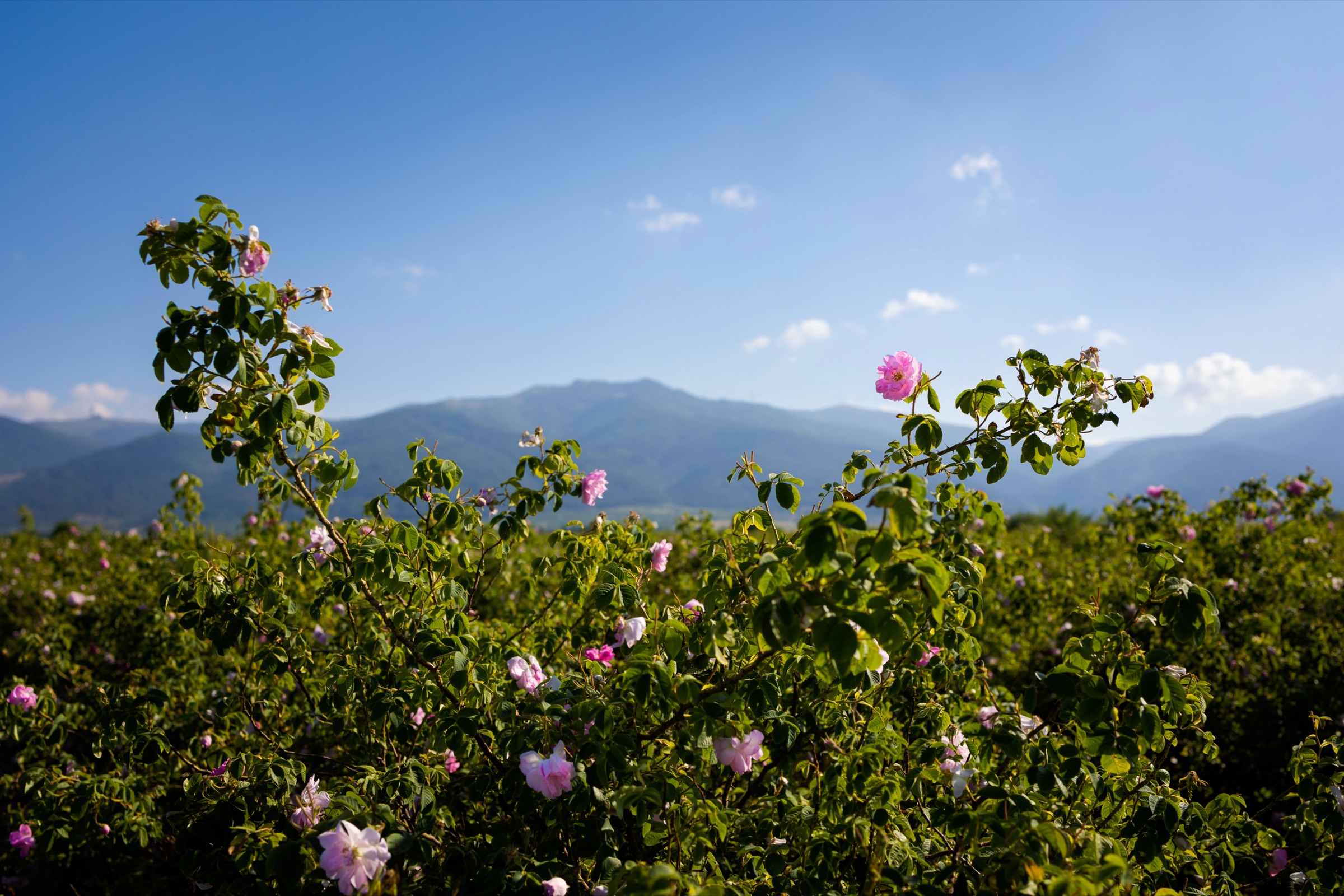
Roughly sixty percent of the world's rose oil production today comes from the Isparta region in the southern Anatolian highlands. The harvest begins in the second week of May and ends by mid-June; the buds are cut by hand, in the cool of the morning between four and seven, before the heat opens the petals and the volatile oils evaporate. A single kilogram of Rosa damascena oil requires roughly three to four tonnes of fresh petals. The cultivation is held by family cooperatives — small, ancestral, mostly unmechanised — that have refused industrial-scale conversion. The rose-growers of Isparta speak of the harvest in seasonal-religious terms; the gül mevsimi (rose-season) is one of the genuine markers of the Anatolian summer calendar.
f) Botanical properties
The essential oil of Rosa damascena is dominated by citronellol, geraniol, nerol, and phenethanol — together carrying the characteristic rose-water aroma. Hydrosols extracted in the traditional copper-still tradition retain only the water-soluble fraction of these compounds, which is why their scent is softer, less concentrated, and noticeably more skin-tolerant than the pure oil. The plant carries tannins in its petals as well, which contribute the mildly astringent finish recorded in the historical use as a wash after the hammam.
g) Regional specificity — what soil and altitude write into the plant
The Isparta harvest produces a chemical balance no other region matches in the same way. Compared to the Bulgarian Kazanlık valley or the Iranian Kashan production, the Isparta rose typically holds a higher concentration of citronellol (between fifteen and twenty-two percent of the volatile fraction) and a noticeably higher phenethanol share, while sitting slightly lower in geraniol than its Iranian counterpart. The resulting profile is rounder, less sharp, and demonstrably more skin-tolerant in clinical patch testing.
Three regional factors write this difference into the petal. The Göller Bölgesi altitude — between one thousand and fifteen hundred metres — exposes the plant to higher ultraviolet radiation, which prompts a measurable increase in secondary metabolite production. The cool nights of the Lake District slow the dissipation of volatile compounds in the hours before harvest. And the calcareous, mineral-rich soils of the basin produce a different ionic environment for the roots than the river-valley conditions of Bulgaria or the more arid Kashan plateau. The continuous family-tradition of hand-cutting between four and seven in the morning — before the rising sun begins to vaporise the surface oils — preserves a portion of the yield that mechanised harvest in other regions routinely loses.
The cosmetic consequences are precise. The higher citronellol fraction carries a documented mild antimicrobial activity and a soft soothing effect on irritated skin — which is why the post-hammam rinse with Isparta rose water settles redness rather than provoking it. The elevated phenethanol gives the hydrosol its unusual stability: traditional rose water from Isparta keeps for weeks without added biocides, because the compound itself contributes to natural preservation. The retained tannins close the pores after the heat of the bath. And — relevant to contemporary regulatory standards — the Isparta harvest's typically lower methyleugenol concentration falls well within the European cosmetic compliance threshold while preserving the full sensorial range.
„Bülbül gülün aşkına yanıyor."
— „The nightingale burns for the love of the rose."
A monthly letter follows on this plant — subscribe in the footer.